My Favorite Novel

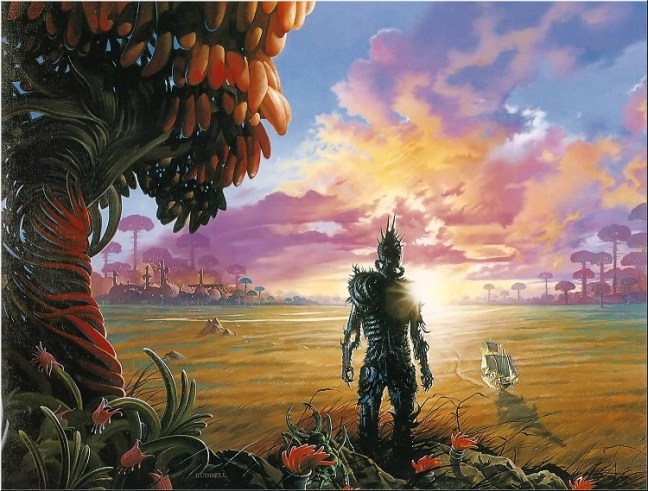
The Shrik, a boat, and a city in the distance

Perhaps my favorite novel is Hyperion/The Fall of Hyperion by Dan Simmons.  Perhaps it would be considered cheating, having a favorite novel comprised of two novels.  However, I don’t think it is, as Hyperion doesn’t really have a proper ending, in any real sense of the word—almost nothing is resolved in the first book. Nevertheless, even if the second book hadn’t been published, Hyperion is still worth reading on its own, though there would be no closure.

What’s it about?

Set in the distant future, Hyperion follows seven pilgrims on their journey to the mysterious Time Tombs. There, legend says that the enigmatic monstrous Shrike will slaughter all but one of the pilgrims and grant the remaining pilgrim their wish.

Hyperion has an unusual, Canterbury Tales-like structure with a large majority of the book comprised of the pilgrims telling each other their stories. I think normally, this structure would completely turn me off, but it in this case, it really works. Each of the stories is in a different sci-fi sub-genre—horror, mystery, military, etc. and each story is compelling in its own right, both in terms of plot and the character development. Yet each piece also fits nicely into the bigger puzzle, the broader story.

Why do I like it?

There are several reasons why I like Hyperion. First, it does the best, most creative world-building I’ve ever seen in a novel. I think it has more cool ideas per page than any other book I’ve read, and, though the world is amazingly complex, as a reader, it never felt as though I was slogging through pages of world-building. Rather, everything was conveyed within the context of the story.

Second, the characters are all compelling and all have distinct personalities that truly shine through in the telling of their stories. As you’d expect, someone would need a compelling reason to volunteer to be on such a pilgrimage, and each of the characters has such a reason. Almost all the characters are sympathetic and emotionally engaging.

Finally, the Shrike and the Time Tombs themselves are fascinating and ambiguous. A monster that does evil because it is malevolent is one thing. At least you can understand such a creature’s motivations. But a monster that does evil for no discernible reason is far worse, and far more interesting.

The bottom line

Other people liked Hyperion too—it won a well-deserved Hugo in 1990. I’d recommend this novel to anyone who enjoys fascinating science fiction ideas.

Five Things that Terrify Me about the Future

Dystopia

One of the interesting things about writing science fiction these days is that you don’t actually need to look far in the future to come up with interesting stories. Whereas historically, technology in Science Fiction was often akin to magic (Star Trek transporters, faster than light travel, etc), there are huge technological advancements right now that make some wacky old Sci-Fi ideas start to seem realistic.

This is great, until you realize that most of those wacky Sci-Fi ideas are actually from dystopias. Thus, here’s my list of the five things that scare me most about the future.

1. Artificial Intelligence

The rise of artificial intelligence (AI) has the potential to be the most transformative event in human history. The challenge is the singularity—an event where the AI becomes smarter than us, able to improve itself beyond what a human could do. When this happens you can get exponential growth in the intelligence and capabilities of the AI.

Even in the best case, if (every) AI is benevolent, almost every job has the potential to be done better and more efficiently by an AI. All those white collar jobs where people are paid to think (i.e. the ones everyone had to transition to when the manufacturing jobs disappeared as a result of automation), will go away. So, this transition could leave vast numbers of people unemployed. While the AI might be able to produce enough for everyone, our social and economic systems aren’t designed around a world where we have plenty of everything and labor is no longer required.

Then there’s the worst case, if the AIs (or even just one AI) aren’t benevolent. Either they could be actively against humans, or simply not care about humans, and pursue their own goals. Hackers can already cause chaos in the world, so what will happen when an AI is a million times smarter than hackers, and has better resources? Maybe it’ll decide to divert all the resources to enhancing its own abilities rather than providing food, shelter, and medicine to humanity. Or maybe it’ll decide that humans are simply in the way. That could be rather bad.

2. Nanotechnology

When you create machines that are really small, you can potentially do a lot of good. You can manufacture extraordinary materials, perform medical feats far beyond the capabilities of drugs or scalpels, or potentially clean up the environment.

The problem is that you can also do bad things, like create self-replicating machines designed to hurt people, or tamper with their brains, or mess with any number of things. The problem is that nanobots are too tiny to be seen and impossible to guard yourself against. You could, in theory, create a nanobot that self-replicates all over the world, and after a specific time period, kills anyone who has blue eyes. And I have blue eyes, so that’s pretty terrible.

3. Genetic Engineering

Genetic engineering has many of the same problems as nanotechnology. I’m not particularly concerned about people meddling with humans (e.g. eliminating genetic defects as a zygote, or creating superhumans.) While those things have huge moral and ethical issues, they are much more likely to result in the evolution of humanity than the rapid, violent extinction of humanity.

The thing that does worry me is the potential for genetically engineered disease, because if people can do it, they will. Like nanotechnology, genetically engineered viruses are basically impossible to guard yourself against. You constantly hear of cases where nasty people say they’ll release embarrassing pictures to Facebook if the victim doesn’t pay them off. So how long will it be before people will infect someone with a customized disease, and only provide an antidote if the victim pays them off?

4. Surveillance

One big change that’s happened in the western world in the last 20 years is the rise of the surveillance state. Largely, this has been ignored—people don’t seem to care if the government reads all their emails or snoops on all their electronic devices. But I think they should, because I think Orwell’s 1984 is a warning.

If we give governments the capability of monitoring everything we do, they will use it. And then, you have the potential for a police state that has complete information on all its citizens, and the ability for a permanent surveillance-based dystopia to arrive. Dictators will be able to do whatever they want, and it will literally be impossible to fight back, since they will be able to detect and crush dissent immediately. Allowing the infrastructure to be put in place that allows that sort of world to be created seems like a bad idea.

5. People’s ability to do bad things

The common thread for many of the items on this list is technology increasing the ability of a few people cause widespread destruction. For instance, I have no doubt that the vast majority of the result of nanotechnology and genetic engineering will be hugely positive. The problem is the 0.1% case when someone uses it for evil has much broader consequences than the misuse of technology today.

Nanotechnology and genetic engineering toolkits will be build that can be used broadly, outside of the cutting-edge university labs. Then, you only need one person who decides that it’s a good idea to create a self-replicating nanobot that blocks the blood flow to people’s hearts, and the game is over. Similarly, you only need one president to decide that the people who disagree with him ideologically are a threat to the state, and then you’ve got a permanent Orwellian dictatorship.

The bottom line

To me, that’s the downside of technological advancement—we’re not that far from a place where one nut job can decide to ruin everything for everyone. Our capitalist system is great at encouraging innovation, but quite poor at putting limits on technology for the good of everyone—heck, we can’t even recognize that drastically changing the planet’s climate when we have nowhere else to live isn’t a good idea.

Stephen Hawking recently said that now is a particularly dangerous time for humanity, that we have created new technological risks that could lead to humanity destroying itself in the next 100 years. I’m inclined to agree with him.

Thoughts on Trump

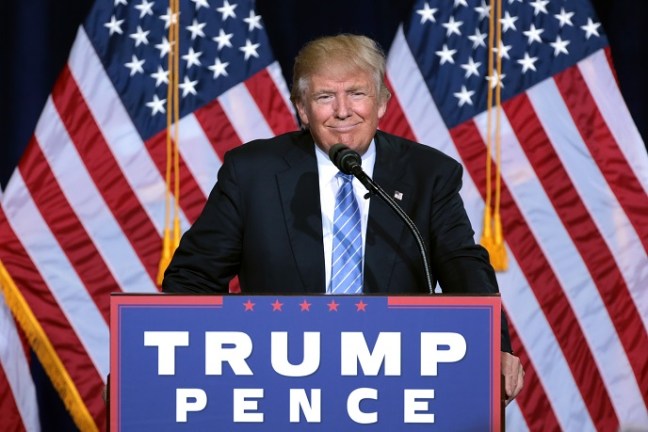
Donald Trump looking pleased.

The results of the recent presidential election in the USA surprised many, including me–very few people expected Trump to be elected. I have three main thoughts on this election.

Swing toward Fascism

On my most recent post on Brexit, I discussed a recent epiphany that I had, that, when widespread inequality exists in society, the people on the bottom recognize that they’re being screwed and try to change things. One would think that a logical consequence of that realization is that they would vote for left-wing politicians, those who promise to reduce the inequality.

However, my epiphany then was that people don’t always leap to the left, but rather just vote for change. This provides the opportunity for a populist, fascist regime to gain power. Fascist regimes are typically described as authoritarian, nationalistic and intolerant.

If you look at Trump, he’s certain waves the national flag constantly (“Make Americal Great Again!”). He is authoritarian (“Trust me, nobody can save me but you”, generally says he’ll achieve a bunch of things without saying how, and wants to throw his political opponent in prison). He is intolerant (“a nasty woman”, “Mexican rapists”, wanting to boot the illegal immigrants). Trump certainly fits the description of a fascist.

Thus, this is another data point supporting my epiphany. When people want change, they don’t always care who brings in that change, or whether it comes from the right or left.

The Narrative Is Mostly Garbage

After this election, people are making sweeping generalizations about what this means for the country, the Democratic Party, the Republican Party, what voters want… basically everything. Essentially everyone in the media is forming a narrative. They want this election to mean something big, to mean that an election strategy or candidate was totally wrong, or totally right, and that this changes everything.

The thing is, if one Trump voter in a hundred actually was a Clinton voter in three states, then Clinton would have won the election. Then there would have been a different narrative about how America had said “No” to everything Trump stands for, and that because of demographics, the Democratic Party would rule until the Republican Party reinvents itself.

Thus, most of these narratives are bunk–you can’t truthfully make any big generalizations when the election is decided by a few tens of thousands of people. But people will anyway.

So, when reading these broad narratives, it’s useful to think—if one person in one hundred had changed their mind, then the narrative would’ve been the exact opposite. And then weight your opinion of the narrative accordingly.

My Narrative

All that said, I’ll give you my narrative. And that’s that the scariest thing Trump is doing is changing the culture. He’s making racism and sexism acceptable. You can already see it.

Sean King’s twitter feed shared some of the instances of racism in the days immediately following Trump’s election. Muslim women being berated and getting their hijabs torn off. A black woman being told, “Pretty soon, it’ll be legal again to own you.” A school teacher telling Latino students that their parents will be deported. Nazi graffiti on walls and in restrooms.

Trump has suddenly made it okay to be racist, to announce it loudly to the world, and act on those beliefs. I think that changes the culture.

To me, the scariest incidents are the ones that happen in the schools. When you’re young, you do stupid things sometimes, and because of Trump, those stupid things are more likely to be racist and sexist. Trump’s put a target on minorities, and some school kids will go there.

Later, when those kids would normally grow out of that stupidity, they might experience cognitive dissonance looking back at they see the things they did (like, “how can I be a good person if I did these bad things to minorities”). And for many of them, the way to resolve that cognitive dissonance will be to become a racist, because to the racist way of thinking, the minorities deserved it.

So, I’m fearful that, for the next four years, Donald Trump will be teaching a whole new generation to become racist.

The bottom line

All that said, the election of Trump will make our lives more interesting. Clinton was the status quo candidate, and Trump was the “change everything” candidate. We will certainly live in interesting times.

My First Novel

The Battlefield Abductions book cover

Today I published my first novel.  Woo hoo!  Here’s the teaser:

For three years running, on the exact same day in May, six students vanished from Erica Trestle’s high school.

The adults deny anything unusual is happening, claiming the teenagers went on exchange programs or moved to other cities. But to Erica, their explanations seem absurd. Why were families moving without warning in the middle of the night? Why wouldn’t the students tell their friends they were going on an exchange program, and why didn’t they return?

When two of the missing teenagers reappear—one catatonic and one dead—most of the students become convinced they are in danger. As the day rolls around again, Erica and her friends scramble for ways to protect themselves against the threat no adult, not even the police, seems to take seriously. In the face of their indifference, Erica is certain the disappearances are a part of a vast conspiracy, more dangerous than anyone imagines.

What she doesn’t realize is that this year—it’s her turn.

Thoughts Brought on by Brexit

The indoctrination of children

I had a shocking realization today. My whole view of the world could be wrong, and Brexit helped me realize it.

How we’re broken

The way the world works is broken. The most effective financial system that we have is capitalism.  It results in goods being produced and shipped to where they are in demand.  In North America, it means that it’s rare to see a product out of stock in a particular store, and even more rare—outside of the latest iPhone—to be unable to purchase a particular product at all.

Capitalism is responsible for that, for bringing together the components needed to make even the simplest product from all over the world, and then bringing the product itself to where it’s needed. It’s magic.

There is a huge problem with capitalism, though. It tends to create gross inequality. The winners in capitalism aren’t just ten times as rich as the losers.  On a net worth basis, they’ll often be a million times richer than the losers. You see that today, where the richest 1% own about 50% of the world’s wealth.

Of course, this doesn’t work very well for the lower 50%. Oddly enough, people don’t care much about absolute levels of wealth, but care a lot about relative measures of wealth. Thus, if you live in a western country with a reliable food source, workable house, functional car, and big screen TV, you don’t necessarily say, “Life is good.”  Instead, you look across the street at the guy who has a mansion, an expensive car, and the home theatre system, and say “I’ve been screwed.”

Thus, gross inequality creates unhappiness and instability.

What’s supposed to happen

In cases like this, the government is supposed to step in to redistribute the wealth, to ensure that the winners still get to be winners, but the losers don’t do as badly. They are supposed to make sure the wealthy dude has only 100 times your wealth, not a million times.  They should allow the rich to be rich enough to provide aspirations to everyone else, while keeping the inequality at reasonable levels.

The problems is that the whole system—politicians, media, corporations, and even academia—runs on money. Thus, politicians can be bought off, persuaded to not enact policies to redistribute the wealth. Academia can be convinced to swing to the right, and their right wing messages distributed through the media for the benefit of the wealthy. (Trickle-down economics, anyone?)

As a consequence, the healthy balancing of economic outcomes doesn’t happen anymore. The politicians do nothing, convinced by money that, by doing nothing, they’re doing the right thing. Or at least lining their own pockets

What I thought would happen

In this scenario, I thought that people would realize that they’re being screwed, and would move to the left. They’d elect politicians who focus on left-wing solutions—single payer healthcare, unemployment insurance, funding for education etc. All the things that will improve income mobility and reduce income inequality.

I think people have certainly realized that they’re being screwed. They see the system isn’t working as it should. I think this is what’s behind the rise of Bernie Sanders. Though Sanders failed this time, my thought was that in four or eight more years, a socialist might actually have a hope of being the Democratic nominee. And it seemed obvious that, even if a socialist doesn’t actually become president, over the long term, society would shift to the left.

Where I went wrong

Brexit has changed my thinking, though. Instead of saying, “our problem is that we don’t have a reasonable distribution of wealth”, opportunistic politicians have said, “our problem is those damn immigrants. If we just got rid of everyone who’s different, all our problems would go away.”

And people have bought it.

This sentiment was a huge factor in the Brexit vote, and a huge factor behind the rise of Trump. Essentially, inequality is leading to fascism.

Even in Vancouver, that sentiment is growing. The only economic issue that matters in Vancouver is housing. The average single family home in Metro Vancouver is $1.83 million.  The average family income is about $74,000. So, the average family has no hope of buying the average home, and would be stupid to do so.  However, this makes the average family angry, and the target of that rage is the Chinese.  Essentially, the Chinese are blamed for pushing up housing prices and there are now cries for the politicians to do something against the outsiders.

So, my shocking realization was that a shift toward socialism might not be the most likely outcome of the gross inequality in our current society. Instead, I suspect fascism is, because it’s such an easy sell.  And I think that’s quite a bad thing.

Where will we end up?

Even worse, 21st century fascism is likely to be far worse than 20th century fascism. Because now we have the ultimate surveillance state. Today, the state can read emails and track people anywhere using both cellphones and ubiquitous cameras with facial recognition. So, whereas in the 20th century dissenters or any persecuted group had some hope of hiding or fighting back, people in the fully-automated 21st century have no hope of escape.

What is it Orwell said? “If you want a vision of the future, imagine a boot stamping on a human face—forever.”

Why Downton Abbey Is Interesting

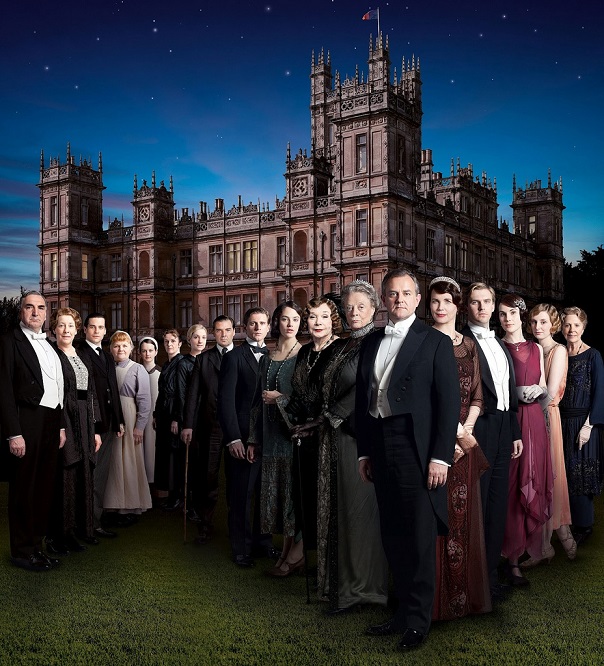
Granthams and Servants

I have recently been watching Downton Abbey, a British TV drama about the family of the fictional Earl of Grantham and their servants from 1912 to 1925. I tend to dislike period pieces, often finding  the writing self-absorbed and characters difficult to empathize with.  Nevertheless, I find Downton Abbey quite compelling, so I was trying to figure out why.

Historical context

Downton runs over a longer time period than many shows and is deeply intertwined with historical events. Many major historical events have a real, permanent impact on the show, which makes Downton Abbey more engaging in several ways. First it adds a puzzle dynamic to the show, where you attempt to explain events based on what was happening in the world at the time. For instance, one of the characters has a severe limp and was in the military. This made me wonder whether he got the injury during the Boer War.

Second, it leads to anticipation about how major worldwide events will impact the family and servants. For instance, when the First World War ends, my first thought wasn’t, “Thank goodness it’s over.” It was, “Don’t celebrate too soon! You’re about to be hit with a huge influenza epidemic that will kill more people than the war itself.” With a show like Downton, you know that a major worldwide epidemic cannot pass without leaving a permanent mark.

Finally, it’s compelling seeing the perspectives on historical events through the eyes of the people at the time. While the writer cheats occasionally—not allowing the main “good” characters to have beliefs that would be commonplace at the time but considered repugnant now—it’s nevertheless interesting seeing the characters’ takes on things like the rise of labor and the women’s suffrage.

Different problems, same human nature

A second thing that makes the show compelling is that many of the problems that the characters encounter aren’t the same problems that we’ve seen a hundred times on contemporary shows. Instead, the problems are products of the times, such as the impropriety of a servant having an affair with a member of the aristocracy or the challenge in maintaining the estate despite capitalism making it non-economic to do so. You start to see the world through a difference lens, where problems that would be completely inconsequential today are world-shaking in the context of the time.

Simultaneously, the characters deal with these problems in human ways and with human emotions, allowing you to empathize with them. The challenges of this historical world are often foreign, but human nature is constant. Thus, the viewer gets drawn into the characters’ troubles.

The upstairs and downstairs interplay

The other compelling thing about the show is that it spends a similar amount of time on both aristocratic family and their servants. Their lives are different, but the value of the people is the same. The Earl has his problems and concerns, and they’re different than those of the scullery maid. But the writer doesn’t imply that the life of the Earl has more meaning than the scullery maid. They’re both just people with different problems, different perspectives, and different jobs.

The interplay between the aristocrats and their servants is also interesting. The Granthams feel a true sense of responsibility for their servants and tenants, and the servants feel a true sense of pride in their job and for the family they work for. In a sense, the servants are an extended part of the Grantham family. That’s not to say that servants don’t get fired. That does happen—sometimes for reasons that don’t make any sense in the modern day.  But to be fired, that trust needs to be broken, or perceived to be broken.

That sort of shared responsibility is particularly interesting considering the cutthroat corporate world today. Corporations typically try hard to convince their employees that they care for them, but it you look at corporate actions, that largely seems to be a tactic to make employees docile and more productive. Instead, the corporate world is largely a matter of dollars and cents, without people having any real ethics or responsibility for each other. Our society has become convinced that greed is good, that ethics are outdated, that capitalism is sufficient justification for any action.

The bottom line

Downton shows that there is a different way of doing things, where people care about people. At the same time, under the onslaught of capitalism, the Grantham estate is crumbling—the Granthams  and their servants trying to adapt to the new world is one of the major ongoing themes of the show. In the end, that sort of interplay between the old and the new, the conservative and the liberal, and the slow but inevitable progression of time are what make the show truly engaging.

The Most Embarrassing Political Incident Last Week

The “big” Canadian political news last week was Justin Trudeau, the Prime Minister of Canada, elbowing a woman in the House of Commons. It took over the media for several days. The “injured” MP claimed she was overwhelmed and had to leave the house to recover. MPs from both the Conservative and NDP parties condemned the Prime Minister, and he apologized.

To me, this is an extremely noteworthy event. It means for the first time since Trump started running for the Republican nomination, the most embarrassing political event of the week didn’t involve Trump.

What really happened

Luckily, there is a video of the entire incident. What actually happened was the NDP clustered on the floor of the House of Commons, deliberately blocking the Conservative Whip from returning to his seat.

The Prime Minister, seeing that the NDP members were being buttheads, pushed through the NDP scrum to retrieve the Whip, and then escorted him through the crowd. In the process, he brushed his elbow against Ruth Ellen Brosseau, the female Member of Parliament representing Berthier-Maskinonge. Brosseau complained to her colleagues and left the house. Trudeau apologized—and tried to apologize to the member directly—and everyone freaked out, including complaints that Trudeau wasn’t living up to his feminist principles.

My interpretation

My interpretation is a bit different than the opposition parties. Basically, the NDP members were trying to disrupt the proper functioning of the parliament by physically impeding other Members of Parliament. For some reason, nobody seems to have a problem with this. But I do.  These members have been elected to govern, not to act like children playing silly games and wasting everyone’s time.

Thus, I understand why Trudeau was frustrated. Perhaps it was undignified for a Prime Minister to stand up and get the Whip himself, but it was no less dignified than Members of Parliament to try to block out the Whip in the first place.

The uproar over the elbow was even more ridiculous and embarrassing. The video shows that he barely touched Brosseau. If she’s injured and traumatized by such a light touch, I imagine the impact of her footfalls as she walks down the street must be nearly incapacitating.  Putting on her clothes in the morning must be traumatizing.  I should caution her not to ride the bus during rush hour—doing so would almost certainly be a death sentence.

The fallout

To me, that there would be such an uproar over a non-incident is deeply embarrassing. There was nothing here. No injury to anyone. Just a bunch of children squealing about nothing.

To say that the Prime Minister’s actions were anti-feminist hurts the feminist movement by reducing the credibility of feminist statements. If someone gets outraged at such a minor incident, then it means that they have no ability to judge what should be considered outrageous. They should be ignored because their opinions aren’t worthy of anyone’s time.

I don’t have a problem with the Prime Minister apologizing for elbowing Brosseau. Politically, he has to. What’s more, at the time of the apology, it may have been unclear to him how uninjured Brosseau actually was. But I do have a problem with the MPs who wasted our time and made a huge deal out of nothing in order to somehow score political points.  To me, they lost political points. Big time.

My bottom line

The interesting thing is that I actually agreed with the NDP on the issue being debated—there’s value in not cutting short the debate on doctor-assisted suicide. But they really lost me with their juvenile tactics and making a huge deal out of nothing. To me, the Prime Minister comes out of this looking good (as does Elizabeth May, who once again took a reasoned stance about what happened).

Where Free Market Capitalism Fails

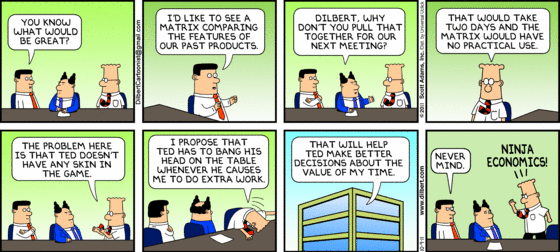
Negative externalities in the workplace.

One of the challenges that we have in today’s world is that much political discussion is driven by ideology rather than evidence. This problem seems to happen on both the right and the left. The left claims that corporations are intrinsically evil and that organized labor is the only real path to a sustainable, fair economy. The right, on the other hand, frequently claims that capitalism—everyone acting in their own best interests—is responsible for the advancement of the world, and that if we just leave the free market alone, it’ll solve all the world’s problems.

Ever since Ronald Reagan, free market capitalism has been on a giant upswing. People with money have recognized that they can buy mindshare for their political beliefs, to the extent that there’s now a popular “news” network that embraces bias, reinterpreting all events through its free-market lens.

To a certain extent, it’s true that free market capitalism can achieve amazing things. Think about all the products available in Target or Walmart. These products are sourced all over the world, yet are almost always available whenever you want them, at amazingly low prices. However, capitalism also has a major problem, and that’s negative externalities.

Negative exter-what???

The way most businesses work is they acquire raw goods, buy machinery and hire people to transform those goods in some way, and then sell the resulting product. If the business wants to be sustainable, it has to sell the product for more than the cost of the raw goods, machinery, and salaries so that it can make a profit. If you can buy steel for $1, pay someone $3 to operate a machine that bends the steel into hedge clippers, and sell the hedge clippers for $10, you’ve got a business. If you can only sell them for $3.50, you won’t last too long.

This is all seems simple and elegant, but a problem arises when there are hidden costs not factored into the price of your product. For instance, suppose the person who mined the iron to make the steel ends up with a bunch of tailings—useless rock after the iron has been removed. The cheapest thing to do with those tailings is to just dump them. However, if runoff rain water from the tailings get into a stream, it might poison the water supply for a town. The poisoned the water supply doesn’t cost the steel company or the hedge clipper company anything, but has a high cost for the people in the town. Thus, this is a negative externality—a cost not borne by the businesses, but someone else.

Similarly, smelting the iron using coal will lead to air pollution, increasing healthcare costs, killing farmers’ fields, and increasing the carbon dioxide in the atmosphere (leading to things like droughts and hurricanes). That air pollution will cost the company nothing, but has a large negative impact on other people.

The consequences

I think negative externalities are the biggest problem with the arguments of people who believe in free-market capitalism. In many cases, the costs are real, potentially higher than the cost of the product itself. Maybe it costs $25 to get a barrel of oil out of the ground, but—depending on how you value human life—the cost of the negative externality of carbon dioxide pollution—causing hurricanes in Florida, drought in the Midwest, and forest fires in California—might be $50.

But the oil industry never sees that the true cost of a barrel of their oil is $75. Rather, they’re making massive profits at that price and will want to pump even more. Thus, the free market is broken because pricing isn’t reflecting actual costs.

The simple solution

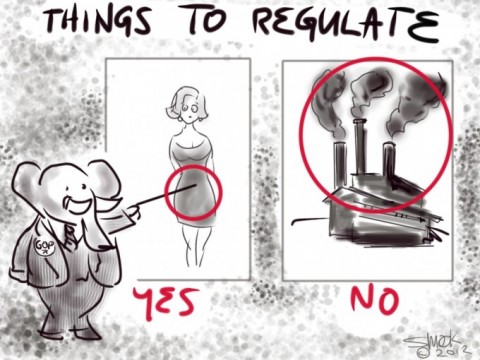
The obvious solution is regulation—either requiring businesses that emit carbon dioxide to stop doing it, or adding taxes so that the true cost of those carbon dioxide emissions are taken into account. Typically, the right wing would protest that such regulations are destroying the market and jobs. To a certain extent they’re right—if you increase the costs of a business, you’ll increase the costs of their product, which will reduce demand, so fewer people need to be hired. However, it’s actually representing the true cost of production, thereby ensuring that the economy is making the “right” decision.

For instance, suppose I decided to create a dog walking service, and to save time and effort, I just dropped off the dogs into your yard to run around all day, tearing up your garden, disturbing your neighbors, and pooping everywhere. You might decide that you didn’t like me doing this, and ask me to stop. Well, it would ridiculous for me to then claim that you’re destroying my business with your silly regulations. What you’re actually trying to do is get me to take into account the negative externalities. (In fact, maybe you’ll say, “you can continue putting the dogs in my yard, but you have to pay me $1000 per month.” That would be the equivalent of the taxing the negative externality.)

Of course, this doesn’t stop the right wing from claiming that regulations are destroying the economy. I guess they’re fine having crap on their lawn.

Why the simple solution doesn’t work

The problem with these sorts of regulations is that the economy is now global. If I force my steel factories to eliminate their carbon emissions, the cost of their steel will increase, and my steel producers will not be competitive with the unregulated steel producers in your country.  So, customers will choose to buy your cheap unregulated steel rather than my pricy regulated steel. I’ll go out of business, and the carbon dioxide will still be pumped into the atmosphere.

There are two solutions I can think of to this problem, neither one of which is great. The first solution is to ensure sensible regulations within trade agreements, so that everyone’s on a level playing field. The problem is that this approach typically doesn’t work well in reality. The steel producers will lobby (bribe) the participants to reduce or eliminate regulation. Countries won’t be able to agree on what’s fair, countries will cheat, and nothing real will get done.

The second approach is tariffs. If products from an external country don’t meet the requirements of my country, then tax them to make up for the negative externality. However, this approach also doesn’t work. First, it’s difficult to do this in a consistent way (like, what if one factory in China meets my regulations, and the others don’t. Can we buy our steel from only that factory?) Second, tariffs will often be viewed as simple protectionism (and much of the time, they probably will be). Finally—and most importantly—it won’t happen because trade agreements forbid it. The country levying the tariff will be sued in international trade courts, and lose. Trade agreements today don’t care about negative externalities, just eliminating tariffs.

The actual solution

So what’s the real solution to these global issues like global warming, where a negative externality has the potential to cause massive harm for everyone?  I don’t know if there is one, other than a unified world government, a cure that might be worse than the sickness. Thus, I think the most likely outcome is that people will fret about these problems indefinitely, nothing will be done to address them, and the problems associated with global warming will explode, making life much harder for everyone.

How Do You Punish Companies?

Punish the innocent, reward the guilty

On my last post, I discussed some instances of corporate malfeasance.  One of the readers commented, that “if a corporation breaks the trust, suspend it for a decade. Liquidate assets to payout non involved employees.”  I don’t think this is the right way to punish corporations, but the general sentiment—putting the consequences of illegal activity on those responsible—is correct, and the question itself is an interesting one. Thus, I’ll discuss how I’d go about punishing corporations for illegal activity.

The Corporate Structure To discuss punishing companies, you have understand the corporate structure.  I’d consider the people associated with the typical large corporation to be in four main roles.

Shareholders: Shareholders own the company, but usually don’t have any direct say in the management or operations of the company.

The Board of Directors: The board of directors—elected by the shareholders, but almost always individuals recommended by the executives—direct the company, design the high-level strategy, and are ultimately responsible for all the actions of the company.

The Executives: The ‘C’-level executives (e.g. CEO, President, CFO) are responsible for managing the company and implementing the directions of the board. In practice, they tend to be as least as strategy-focussed as the board, and likely guide the board as much as the board guides them.

The workers: These are all the people who work for the company but aren’t actually part of the executive team.

Of course, these positions aren’t mutually exclusive. Almost always, the CEO is also a shareholder and a member of the board.

How punishment works today

So, let’s look at the 2007-2008 banking crisis that nearly destroyed the world’s economy, driving millions of people out of work. It happened because banks gave loans to people who couldn’t actually afford the loans, packaged them together, and fraudulently claimed that the loans and package as a whole were higher quality than they actually were. Then they paid the rating agencies to agree, so they could sell those bad loans to investors who had no clue what sort of crap they were buying.

Thus, if you look at who was responsible for this crisis, you should give credit to both the workers who misrepresented the loans and the executives and board who were encouraging this fraudulent activity because it grew the company and increased their bonuses.

Seeing this malfeasance from these individuals, the SEC’s response was to allow the board, executives and workers to keep their fraudulently-accumulated wealth, and punish the shareholders by fining the companies large amounts of money (for the biggest players, tens of billions of dollars). Thus, the people in the corporate organization who were most responsible were rewarded, and the people least responsible were punished.

Suspending the corporation

Let’s go back to the idea of suspending the corporation and paying out assets to the non-involved employees. I see a few problems with this approach. First, most of the value of big corporations isn’t in their assets. For instance, Coke (NYSE: KO) has an enterprise value of $217 billion—that’s what the market thinks the company is worth.  But they only have assets of $25 billion.

The difference is because Coke as an operating company is worth far more than its assets. Think about it. Would you rather have a bunch of trucks, a big mound of sugar, and a few factories and warehouses, or would you rather have distribution agreements with millions of stores and restaurants, a brand that almost everyone on earth recognizes, and the recipe for a semi-addictive product that people constantly purchase? Thus, if we suspend the company and distribute its assets, we’re destroying most of the value of the corporation.

Second, this approach, too, would mostly punish shareholders rather than the people responsible—the board and executives. The shareholders would lose everything, the board and execs would keep their ill-gotten wealth.

Third, shutting down massive corporations would leave a huge hole in the economy and would be politically controversial. For politicians to be willing to do this, the corporation would have to be loathed. Otherwise, politician’s own incentives would make them unwilling to take such drastic action. Thus, suspension might exist as an ultimate punishment, but in practice would never actually be used.

My solution

Instead, I’d like to punish the “corporation” by throwing the people responsible in jail and clawing back their illegally obtained wealth. As such, I think top level executives and board members should almost always be held responsible for major violations by their companies, regardless of whether or not it can be proven that they “knew”. Their job is to know, and—for major violations—it seems likely to me that almost always the executive would know (or have deliberately created a culture that encouraged violations). The punishments should typically involve both significant jail time and fines equal to or greater than to the ill-acquired wealth.

On top of this, I’d make director’s insurance (which pays for lawsuits against board members), illegal. In effect, director’s insurance moves the costs of a director’s illegal activity from the director to the shareholders. I’d consider products that transfer the costs for illegal activity from the guilty to the innocent to have negative value to society.

This approach would certainly make it riskier being a top executive, but that could become part of the reason why CEOs are paid 350 times what the average worker is. Plus, if a particular issue could get a CEO thrown in jail, I suspect that CEO will pay much more attention to that issue than they would otherwise. If, as a result, corporations care less about money and more about being squeaky clean, it will lower profits, but likely result in a better world.

The challenge

The biggest challenge with this approach is that it has to be based on law. If we use a vague standard like “breaks the trust”, we’ll end up with politicians’ enemies in jail, and politicians’ donors doing whatever the heck they want. So, we need the prosecution of corporate offenders based on law, to at least give us a fighting chance of going after people that the politicians like.

One problem, however, is that you can’t encode good behavior in law. Take Nestlé. In third-world countries, they contributed free formula to new mothers in hospitals. Mothers who accepted the formula would stop lactating and were forced to continue buying it when they returned home, hurting both babies and parents. Nevertheless, regardless of how unethical this strategy is, it’s hard to think of a law that could be created to prevent it. (Are you really going to stop corporations from donating goods to helping children in hospitals?)

The bottom line

Maybe in the long term, we could create a “don’t be an jerk” law, which would be considered broken if 95% of the population polled think someone’s being a jerk. Implementing that sort of law is feasible with online voting, but it isn’t likely to be seriously considered (not the least because, if it did exist, the first people to break it would probably be politicians, the guys who make the laws). Thus, I think the combination of reasonable corporate laws, easier standards to prove the culpability of executives in their company’s malfeasance, and jail time and fines is the best way to deal with corporate crime today.

Why Regulate?

What should we regulate?

The invisible hand of capitalism is amazing. If you go into a store, the goods you want are almost always there. If you think about it, this is astonishing, considering that the goods will often be manufactured halfway around the world from raw materials sourced from a multitude of countries. One can’t design the economy to work so efficiently, bringing goods and materials to where they’re needed when they’re needed. Frankly, the beauty of how it all shakes out leaves me in awe.

So, I understand why some people view capitalism with reverence, believing that the government should keep its hands off, letting people and corporations do whatever they believe is in their own self-interest. The problem is people always seem to be willing to let it go too far, and you start to find examples where the beauty turns to ugliness.

Enron

At one time, Enron was the darling of the energy industry. It was even named American’s Most Innovative Company by Fortune for six straight years. The problem was, one of their innovations was in creative accounting, resulting in a company with $111 billion in revenues plunging into bankruptcy.

To me, however, the most interesting part of that story wasn’t the fraud, but rather the manipulation of the energy markets. During California’s energy crisis, Enron encouraged energy suppliers to shut down power plants. This led to rolling blackouts, causing the price of energy to spike exponentially, up to twenty times its normal peak values. Of course, the lack of electricity inconvenienced both businesses and consumers. I imagine it probably killed a few people who depended on air conditioning or relied on electricity to power medical equipment. But Enron made money, so they viewed such issues as irrelevant.

Bayer

In the early 1980s, Bayer was selling a hemophilia drug, Factor VIII, make from human blood plasma. When AIDS came along, they discovered some instances where Factor VIII was contaminated with the virus. The drug was made in large batches and there was no test for AIDS yet, so it wasn’t possible to determine which batches were contaminated, and which weren’t. So, the drug was banned in the USA.

That was a problem for Bayer. It had all these drugs—and was continuing to make more for months after the ban—but couldn’t sell them in its biggest market. Throwing them away would cost Bayer millions. Instead, of destroying them, they shipped them overseas, continuing to sell for another year. In Hong Kong and Taiwan alone, over 100 hemophiliacs using the medication contracted HIV.

Nestlé

Nestlé, too, had a problem. They weren’t selling enough baby formula, particularly in underdeveloped countries. For them it was a nearly insurmountable challenge: their baby formula didn’t stack up well against the primary competing food for babies—mother’s milk. Mother’s milk is free, has nutrients and antibodies not present in formula, and doesn’t rely on having a clean source of water—a rarity in some countries. How on earth could Nestlé sell its product when mother’s milk was so compelling, so clearly superior?

Nestlé proved to be up to the task, creating a brilliant marketing strategy. They supplied the infant formula to hospitals for free. New mothers would start their babies on the formula, and, as a result, would often have problems with lactation. Thus, when they left the hospital, they wouldn’t have breast milk to feed their babies, and would be forced to pay for the formula. Maybe some babies died from the lack of clean water and some were malnourished, but Nestlé finally had a market for its baby formula in poor countries.

Luckily, Nestlé also has a solution to the lack of clean water—privatization. Their Chairman has said before that access to water isn’t a public right (though he has since backtracked). Nestlé’s approach is that governments should sell the groundwater that is currently being consumed by the people to Nestlé, allowing the company to package it into bottles. They will then sell it back to the people who are currently consuming it for free. Because there will be a price on water, then there will be less wastage (and larger profits to Nestlé). And, if you’re too poor to afford Nestlé’s water, they’ll benevolently give you just enough to survive (but not bathe. That would be wasteful.)

GM & Ford

The auto manufacturers provide other good examples of tradeoffs that corporations make. Take the Ford Pinto. This car was rushed to production despite pre-production tests that showed that low-speed rear collisions could cause the fuel tank to rupture and explode. This was a big problem for the company, since the fix was estimated to cost $137 million. Luckily, Ford had some good mathematicians on staff. They figured out that settling the claims from burn victims would probably be less than $50 million. Thus, they didn’t bother fixing the car.

Decades later, GM had a similar safety issue with faulty ignition switches that could cause the engine to shut off when driving at high speeds. This could not only cause an accident, but also prevent the airbags from inflating. Luckily, GMs had learned from Ford what the right thing was to do in such a situation. They calculated the cost of a recall, decided it was quite high, so skipped it. It took a decade before they finally recalled their faulty vehicles. By that time, hundreds of people had died as a result of the issue.

The debate

The free market proponent would argue that the invisible hand will fix these sorts of problems itself. If Pintos explode, people will eventually realize it, and stop buying Ford’s products. There are a couple of problems with this sort of argument, though.

First, it doesn’t help much if you’re one of the thousands who die. Second, as Ford, GM, and Bayer show, there are situations where the company can make more money by selling a dangerous product than fixing its problems. (Heck, why not be a snake oil salesman? You’ll only sell a million dollars worth of fraud before you’re discovered, but by then you’ll have their money and a million dollars is still a million dollars.) Third, there can be situations, like Enron or the Mafia, where you can deliberately cause misery that you can profit from. It’ll show up as positive in the GDP, but really, you’re destroying value, not creating it.

The bottom line

The way around these issues is by sensible regulation that reflects our values, such as making the cost of a human life so high that it rarely makes sense for a company to kill its customers. Or, by forbidding companies from selling unsafe products, and throwing the corporate leaders in jail when they do. In the end, it all comes down to deciding what sort of world we want to live in.