Increasing Income Disparity

Income disparity has never been so high, and the Occupy Wall Street and other rallies around North America–while largely unsuccessful–show that people are starting to care. Even so, without some sort of intervention, these disparities are likely to increase.

Success often breeds success, for two reasons.  First, people sometimes are successful not because of luck, but because they are more skilled. Where this is the case, you’d expect this skill to give them an advantage in future endeavors.  Second, success often results in competitive advantages that increase with size, such as economies of scale and networking effects. So, once you start winning, the game gets much easier. The rich get richer.

But the rich getting richer is only half of the equation.  I think it is also likely that the poor will get poorer.

Being unskilled sucks

Much of the work that people have done in the past is now being automated. Instead of weaving the fabric to make shirts, we have gigantic industrial looms that are far more productive than people. This is a good thing in general, since we get the goods we want at a cheaper cost. In effect, automation is magnifying the efforts of a few, so that a few people can potentially satisfy the needs of hundreds or thousands.

But this leads to a big problem. In our current economic system, automation should naturally widen the gulf between the rich and the poor.  Those who control the means of production will create even more wealth. The poor, on the other hand, will no longer even be required as labor for goods production. If machines are doing all unskilled labor, the value of unskilled labor plummets, and the poor should become even poorer.

This hypothetical world isn’t great, even for the rich. The rich actually need the poor to purchase their widgets. If the poor can’t afford to buy the widgets, then the rich won’t be nearly as well off as they could be. Plus, if the divide between the rich and the poor becomes too large, it increases the chance that the poor will rise up, kill the rich, and take their stuff.

Are we there yet?

Some people are starting to argue that we’ve already passed the tipping point for automation.  The recovery from the 2008 Great Recession has been the slowest ever.  Historically, jobs lost during a recession come back within a couple years.  With the Great Recession, it took over six years for the number of jobs in the USA to reach peak pre-recession levels.

There is speculation about why this recovery was so slow. This certainly wasn’t a typical recession. In 2008-2009, there was a real risk of the global banking system collapsing. The job losses were huge compared to previous recessions.  That interest rates are still at “emergency” levels shows how worried the Federal Reserve continues to be. So, maybe the recovery is slow simply because the recession was huge.

Or, maybe the slow recovery is a side-effect of globalization, as large companies offshore anything that can be offshored.  Labor costs are so much lower in other countries that perhaps we shouldn’t be surprised that companies are prioritizing hiring overseas to hiring in North America.

Or perhaps this is a consequence of automation. During the recession, companies had to become more efficient to keep their profits high. So perhaps they did that through automation–permanently eliminating jobs when a computer or robot could easily replace a human in a job.

My view

Which one of these three explanations is correct?  I suspect all three, with the biggest factor being globalization. The combination of the Internet, structured Web Services, and improved logistics have made it more feasible than ever to outsource a production all over the globe.

In my personal experience working with large companies–and remember I have a tech background–I’ve seen the impact of automation and globalization. I’ve seen many cases where people were hired to talk to workers to determine how they do their job, so that they could make a computer do it instead and layoff the workers.

But I’ve also seen places where outsourcing wins. In one case, there was a highly-repetitive job involving searching structured data for anomalies–a task at which computers excel. A natural task to automate.

But in this case, the business decided to outsource the job.  It was cheaper to hire Chinese workers to do this mind-numbingly boring work for years than it was to create and maintain an automated system.

The Chinese themselves make the same decisions. To a North American, many Chinese factories look primitive, not even using much of the basic automation that has been in place over here for decades. But for them, it’s often cheaper to hire people to do repetitive jobs than it is to purchase machinery with a high upfront cost that requires ongoing maintenance by a skilled technician.

The bottom line

So at this point, I think global labor arbitrage is a more significant factor in job losses than automation. Nevertheless, it seems clear that automation will be hugely important in the labor market going forward, and we could eventually reach the point where unskilled labor is essentially worthless.  In my next blog entry, I’ll discuss one proposed solution to this problem, the minimum guaranteed income.

Guilty Until Proven Innocent

Bart and John, two professional poker players, were driving home after a poker tournament.  They had a great time and had won. As a result, they were returning home with about $100,000 in cash. That sum of money isn’t that unusual for professional poker players. You need cash to play and at the highest stakes, $100,000 wouldn’t be considered excessive.

A police officer pulled them over arbitrarily, pretending that they hadn’t signed when they changed lanes (though a dashboard camera later proved that they had).  The cop illegally stalled them, then illegally searched their car, then, when he found the cash, stole the money.

Welcome to the exciting world of civil forfeiture, where police officers can steal people’s assets to fund their operations.

How to legally steal

The idea of civil forfeiture is, if police officers suspect money is related to a crime, they can seize it without any sort of due process, and use the proceeds to fund their own departments,.  If the victim wants to get their cash back, they have to go through lengthy court proceedings at their own expense, to prove that their property was acquired legally.  If they don’t have the money to do so (because, say, their life savings were just taken by the police), or if they don’t have a way of showing that the money was not acquired illegally, they’re out of luck.

The reasoning behind this idea is simple. Fighting a war against drugs requires cash. Funding that war from seized funds is a double win–the drug lords lose the money and the dirty money is used for a good purpose.

A nice idea, but…

On the face of it, this idea is great–an easy way to fight the bad guys with their own money. But it doesn’t work well in the real world. First, it completely ignores any sort of due process or property rights. It’s not illegal to carry huge sums of cash, and there’s a reason we have property rights and courts of law–to ensure that everyone gets a chance to present the best argument in their favor and justice is done.

If you don’t think this is a big deal, then perhaps we should take the next logical step. In states with the death penalty, if a police officer thinks that someone may have committed murder, they should just be allowed to shoot them dead. Like civil forfeiture, this instant justice strategy will save a lot of time and legal costs, and the policemen are probably right most of the time anyway. (Heck, with all the police shootings recently, maybe we’re doing this already anyway.)

Bad incentives

The other problem with civil forfeiture is that it is vulnerable to the incentives. In essence, you’re paying cops to illegally search and steal money. If a cop knows that their department will get any money they find, they will be particularly incentivized to make up any reason to search vehicles and houses. In many of the cases where money and assets are seized, it won’t be worth the time or cost for the victim to prove the money is legally theirs, so that means civil forfeitures are free money to the police.

I imagine that for many police officers, it’s like a scratch and win lottery ticket. You stop a car and often finding nothing, but occasionally get a big win. Woo hoo! If they haven’t already, I imagine they’ll create rules of thumb for the maximum amount of money they can steal before people are willing to take them to court to get their money back. Perhaps they’ll even create more complicated models where they plug in the victim’s demographics, vehicle, and home address and it will spit out an estimate of the amount of money they can take.  Just another form of data mining for business….

In general, it’s a bad strategy to put incentives into place that encourage people to do bad things, since it will almost always increase the likelihood of people doing bad things.  Not all cops will, but enough will to make civil forfeiture a terrible idea.

The bottom line

Bart and John did get their money back. Three years and thousands of dollars later. After all, they were “lucky” enough to have so much money stolen from them that it was worth their time to go through the courts to get it back. But even so. Three years!

These civil forfeiture laws will likely remain. Though they really screw over some law-abiding citizens, those people are only a tiny fraction of the population. Thus, we’re in a situation where the police will want civil forfeiture a lot, since it benefits them greatly, and people, in aggregate, will only dislike it a bit. In any situation where a small minority wants something a lot, and the vast majority don’t want it, but don’t have extremely strong feelings, the former will always win.

So don’t expect any justice here.

Some Asymmetric Bet Opportunities

In my last two blogs, I’ve talked about the value in making asymmetric bets, bets where the risk of loss is small compared to the possible gain.  My theory is that one way to do well in life is by continuously making asymmetric bets that have positive expected outcomes.

So far, most of this discussion has been rather theoretical, so it’s worth discussing some of the real-life ways where such a strategy might apply and some of the challenges in implementing it.

Getting a college education: This strategy might not seem that asymmetric–spending years and thousands of dollars on a college education hardly seems low risk and low cost. But most studies that I’ve seen indicate that a college degree still has a significantly positive economic return, and likely has a return in terms of satisfaction with life, also.

Driving safely: Wearing a seatbelt, signalling, and shoulder checking when doing lane changes have almost no cost, but a huge potential reward for avoiding and reducing the cost of accidents.

Being friendly and polite: There is almost no cost to not alienating people, but the returns can be high, both in terms of happiness and future opportunities.

Investing in value: Buying a stock for less than it’s worth is a low-risk/high reward bet. The stock is unlikely to fall even farther below fair value and the value of your investment can increase not just from growth of the business, but also from the return of the stock to its fair value.

Acquiring stock options: Whether you purchase undervalued stock options on exchanges or negotiate for them as part of your work compensation, stock options often offer an asymmetric risk and reward situation.

Starting a high-upside business: A business like a corner store is high-risk, low reward, but many high tech businesses can be low risk relative to the potential rewards, simply because the rewards are so huge.

Doing hobbies that pay : Hobbies that pay (e.g. making and selling things on Etsy) can be asymmetric, because, if you like the hobby enough that you would do it without being paid, then the marginal cost of the hobby is nothing. That makes for an asymmetric situation–no risk for some reward.

Buying a house: In places where the long-term cost of owning a house is less than or equal to the cost of renting, owning your residence is a low-risk/high rewards bet.

Borrowing to invest: If you don’t have many assets, a reasonable strategy is to borrow as much as possible to invest, since you can make a lot if you win, and declare bankruptcy if you lose. Once you have significant assets, this is a poor strategy, since gambling what you need in order to acquire things you want is stupid.

Acquiring memories rather than products: While money does buy happiness (higher income earners are happier), studies of happiness also show that people tend to gain more happiness from experiences (playing board games with the family) than things (that gargantuan TV). What’s more, experiences are often cheaper, so they are often a low-risk/high reward asymmetric bet.

Held back by your brain

Of all these asymmetric bets, the money-making opportunities are some of the most interesting, because they are so clear cut. The injuries and emotional trauma resulting from a car accident are difficult to quantify. But many of the money-making opportunities are easy to analyse. “Can I bet $1 to earn an expected $2” is a simple, clear-cut proposition.

If that’s the case, it ought to be easy making money from such asymmetric bets. So why doesn’t everyone do it?

I think there are three psychological reasons why people don’t.

The first is the valuation problem that I discussed my last post, the difficulty in deciding whether the expected value of the asymmetric bet is worth the cost. The solution to that issue is to not get hung up on exact valuations, but rather focus on being approximately right with a reasonable margin of safety.

Taking a punch, or a hundred punches

The second reason is that investing in asymmetric opportunities is often a high-variance strategy with a low win rate. Suppose you’re making a bet that has a 100 times payoff, but you only win 5% of the time.  This is a good bet to make, since, on average, you’ll make five times your wager.

But you’re going to lose a lot, and that will be hard to take. If you do this bet 1000 times, there is a 99% chance you have a streak of 50 consecutive losses, and almost a 25% chance of having a streak of 100 consecutive losses.  Losing so frequently is psychologically difficult, and might be enough to make you doubt your strategy. What’s more, if you don’t manage your bet-sizing well, you could go broke from a single bad streak.

In such cases, I think the key is to do sensible bankroll management to make sure you don’t go broke. Then, go through your analysis again, and, if you’re convinced it’s right, trust it. After all, in those 1000 bets, you also have an 11% chance of winning 3 times in a row.

Greed is good

The third, related reason people don’t win using this strategy is because they are often psychologically more inclined to take the bird in the hand than the sixteen in the bush. With many options, once the bet starts to go in your favor, you can often cash out quickly for a smaller win.

For instance, if you have purchased a stock option and the stock has moved slightly in your direction, you could sell your option immediately for a profit. If you’ve done a sports parlay (betting on multiple games and needing to win all the games to win the wager), you could bet “against yourself” once you’ve won several of the games in order to “lock in” a win.

But doing so is often a bad idea because you need the huge wins in order to make up for the frequent small losses.

Let’s look at a simple example. Suppose that, according to your analysis, a bet has a 20% chance of returning ten times the amount wagered (and an 80% chance of losing everything). On average, you’ll double your money.  But then imagine, after the bet has started to swing in your favor, you have the option to “cash out”, doubling your initial investment.

If you do this with all the winning bets, but none of the losing bets, then you’ve effectively changed the proposition from having a 20% chance of winning ten times your bet to a 20% chance of winning two times your bet. This is obviously a terrible idea.  The expected return on your initial bet has fallen from a 100% gain to a 60% loss.

So, though it might be psychologically easier to take the “sure win”, it can pay to be greedy. This is particularly true if your analysis indicates that you’re pruning your big wins without also getting rid of most of the losses.

The bottom line              

I think that identifying asymmetric risk/reward situations can make you wealthier and happier. If you keep your eyes open to these opportunities and maximize the value you receive from them, you are likely to live a better life. The key is to not be discouraged if a small risk doesn’t pay off. That’s why you are deliberately keeping your risks small. Over a lifetime, the outcomes will approach the expected results, and you will do very well.

Become Rich Through Asymmetric Risk/Reward

Suppose we make a deal. You’ll give me $1 and we’ll flip a coin.  If it comes up heads, I’ll give you nothing. If it comes up tails, I’ll give you $5.

This is clearly a good deal for you.  In fact, you can calculate exactly how good. 50% of the time, you get nothing. 50% of the time, you get $5.  So, you are spending $1 to get something that on average is worth $2.50. The risk and reward are asymmetric–you are risking far less than you are likely to get back.

That doesn’t mean that when we make this deal, you will win. Half the time you’ll lose your dollar.  But if you play this game over and over, with me or other people, you’ll win over time. Finding these sorts of asymmetric bets is one way to get rich.

Bringing it back to optionality

In life, the optionality I discussed in my last post is often closely related to asymmetric bets. You don’t want to burn bridges because the benefit of burning a bridge is often low (momentary pleasure at telling someone to get lost?), while, sometime in the future, the value of that bridge might end up being high (e.g. an acquaintance helps you find you a new, high-paying job). Not burning that bridge both maximizes optionality and is almost always an asymmetric bet because the cost is so low that almost any future gain would be larger than the cost.

When you start to apply this sort of reasoning to your finances, it suggests a simple strategy to make money. Look for opportunities where there are a variety of outcomes, but you can determine roughly what the expected value of the outcomes is. Then, pay less than that value

In poker, as in life

Poker professionals have figured this out. Texas Hold’em has four rounds of betting. In the first round, you have only two cards, and the ultimate value of your hand is very uncertain. In the second round, the ultimate value of your hand is far better defined. The third and fourth rounds can improve your hand, but more often than not, do not impact it.

This seems straightforward, but things get tricky when you actually start playing. If you look at the odds, against one opponent who has two random cards, you are over 50% likely to win with a King and a Four of different suits.  You’re only 43% likely to win with a Seven and a Six of the same suit.   So, with a naive strategy, you’d want to play the King/Four and fold the Seven/Six.

But among professionals, the opposite is true.

The seven/six has good potential to make powerful hands like straights and flushes, and, when it makes one of those hands, the payoff can be large. What’s more, when it doesn’t make a powerful hand, it will be a clear loser, and making it easy to cut your losses. The king/four has the opposite issue. It will win the majority of the hands, but most of the time, it won’t make a flush or straight that is an obvious winner.

So, professionals recognize that it’s worth wagering a small amount on the Seven/Six because of the optionality it provides and the asymmetric risk and reward. If they hit a great hand, they have the option to bet large amounts and win a large pot. If they don’t hit, they can just give up, costing them very little. With the king/four, even though they win most of the time, their hand will almost never be strong enough that it is worth the risk playing a large pot.

Thus, the poker pros are correctly valuing six/seven higher than the king/four because of its optionality, despite the latter being more likely to be an ultimate winner.

The valuation problem

The biggest challenge of using this strategy in real life (as opposed to gambling) is that it is often difficult to determine the value of an option, since it depends on the probability and value of all possible outcomes.  Often, it’s difficult enumerating all the outcomes, let alone accurately estimating the probability of each one.  If you can’t decide on how likely a single outcome is, how can you hope to ever value the aggregate of a bunch of outcomes?

For instance, suppose you’re trying to decide whether or not to invest in a start-up company. It could fail. It could succeed, but never be big. It could become big. Or it could become the next Apple.  How do you know how likely each one of these possibilities is?

The answer is that it doesn’t matter.

You don’t need to be accurate, only roughly right. After you’ve come up with an estimate for the fair value of the option, build in a margin of safety by paying far less for the option than your estimate. That way, even if you’re incorrect about the probability or value of one or all of the outcomes, you are still in a good position. And, if you’re a pessimist, your valuation estimates might be on the low side rather than on the high side, leading to even greater gains.

By paying far less than the option is worth, you’re ensuring that the risk/reward is asymmetric and in your favor.

The bottom line

Optionality often leads to opportunities for asymmetric risks and rewards. People in general seem to underestimate the value of these opportunities, but if you are aware of them, you should be able to profit.

In my next blog, I’ll talk about some of the challenges in searching for these sorts of asymmetric opportunities and give examples of places where you might find them.

Keeping your Options Open

We’ve all had one of those discussions. What would happen if you were transported twenty years back in time? What would you do differently and how would it affect you today?  Typically, someone will say that they would invest all their money in Apple or bet everything on a particular team winning the Super Bowl, and they’d be rich today.

These discussions are fun, but I also think they highlight the benefits of one of the most effective strategies for life, a strategy that isn’t discussed much or actively pursued by many: optionality.

What the heck’s optionality?

By optionality, I mean keeping your options open, delaying decisions so as to maximize your future flexibility and trying to minimize decisions that close doors.

We can’t see the future, but we know from experience that random stuff will happen. Friendships will form and disintegrate, new people will enter your life, earthquakes, car accidents, and sicknesses will impact you and your family. Even your attitudes and opinions will change. Optionality gives you the maximum flexibility to respond to these unpredictable changes.

So, maximizing optionality is the closest thing we have to time travel. It both increases the number the opportunities that will arise (because you haven’t prematurely closed the door on the opportunity), and maximizes your flexibility to take advantage of those opportunities.

Don’t burn bridges

People do see optionality as a good thing. For instance, the “Don’t burn bridges” maxim recommends that you maintain optionality. It’s saying that even if someone isn’t useful to you now, you shouldn’t alienate them without a good reason because they might be useful to you later.

However, more often, our world discourages optionality because so much of business revolves around sales and marketing. If I’m selling a product, I want you to buy it this instant, not go away and think about whether you truly need what I’m selling or what other things you can buy instead of my whizzbang new gadget. I want you to make a quick decision that reduces your optionality for my own benefit.

Thus, while theoretically people seem view optionality as a good thing, in practice, maximizing optionality tends to be discouraged.

How to Maintain Optionality

One of the key ways to maintain optionality is simply to factor it into your decision-making process. Whenever you need to make a decision, think about whether you actually have to make the decision now, or if you can defer it until you have more information. Deferred gratification is a great strategy for improving optionality.

Secondly, think about which doors will be opened by the decision, and which doors will be closed. If more doors are closing than opening, you have to be completely certain that you care much more about the door you’re opening than the ones you’re closing.

Be greedy

Money, of course, has, high optionality. You can trade it for most things, even time.  If you don’t have a lot of money, a huge proportion of your life will be spent working, and most of the money you make at your job will go to the basic necessities of survival–food, shelter, and taxes. What’s more, if an unforeseen crisis hits (e.g. car accident, medical bills), you might end up having a bad outcome simply because you don’t have the money and flexibility to handle the unexpected costs.

Debt is even a bigger killer of optionality than poverty.  If you go into debt by spending more than you save today, you’re essentially saying, “the future is random, but my desire to spend money now is likely to be higher than my need to spend money some time in the future.” You have to be in pretty dire straits for that actually to be true.

Another obvious method of increasing optionality is education.  Typically, education will provide more opportunities in the future, to the extent that the increased optionality of the education will often compensate for debt taken on to get it. If you don’t think your education will open more doors than it closes, you should really question whether school is worth doing.

Once you start thinking about optionality, you’ll see it everywhere. Very often, you will be offered options and flexibility at a very low cost. When you see such opportunities, grab them.

Where’s the line?

The fact that having more money is better than having less isn’t exactly a brilliant insight, but I think it’s noteworthy because while people know this, they don’t act that way. To use an extreme example, when you buy that frappuccino, you’re probably not thinking that, ten years in the future when you get cancer, the money you are spending today might be enough to make the difference between a successful treatment and death.

All of this is not to say that nobody should buy coffee, buy a house (huge cost, high risk, less flexibility to move) or get married (permanently connecting yourself to someone else in sickness or health? Yikes!)  Rather, the point is that there’s a lot of value in analysing your decisions in terms of what doors they open, even day-to-day decisions like how much money to spend and how much to save. For big decisions like marriage, you should think through what you’re giving up to achieve these goals, and makes sure you’re happy with the trade-offs.

Thus, to make life easier, consider adding optionality to your decision process. By doing so, you’ll maximize the chance for good things to happen to you and your ability to take full advantage of the situation when they do.

On that theme, in my next post, I’ll talk about how to use optionality to get rich.

Reward Speculation, Punish Prudence

The pain of inflation

In my last blog post, I talked about how the origins of the Canadian housing bubble and how it will likely have a huge negative impact on the long-term finances of a generation. I was perhaps a bit one sided—hundreds of bankers still claim there is no bubble. So I’d like to talk about the claim of the anti-bubble arguments and discuss one way the Bank of Canada is looking to get us out of this mess.

Anti-bubble arguments

There are two main reasons that people claim there isn’t a housing bubble. The first is basically, “people can afford their mortgage payments”. The second is, “borrowings are reasonable compared to asset values.”

The problem is that both these arguments are dependent on the party continuing indefinitely. A recession could cause people to lose their jobs, becoming unable to pay for their mortgages, and simultaneously drive down asset values.

Higher interest rates could have the same effect. Canadians typically only have the rate on their mortgage locked in for five years. If interest rates go up, people may not be able to afford the higher rates. What’s more, asset values in general are inversely correlated to interest rates. If interest rates increase, the value of all assets–including real estate–decreases (because if I can invest in a home that makes 3% a year or a bond that pays 7% per year, the bond is a no-brainer).

The typical Vancouverite’s response to this argument is “interest rates can’t go up, because everyone would be screwed.” Perhaps they should ask someone in Greece whether the government controls long-term interest rates.

Correlation causes problems

These two “no housing bubble” claims are particularly problematic because people’s ability to pay loans and the ratio of debt to asset value are often correlated, both on the way up and on the way down. The time when people start failing to afford their mortgage payments will also be the time when falling asset prices will result in debt becoming unreasonably high compared to asset values.

This correlation can cause a crash. When borrowers can’t pay their mortgage and lenders refuse to lend because the asset values do not support the mortgage, it can caused forced selling, driving down prices. The reduction in asset values makes lenders even less willing to lend. This sort of self-perpetuating feedback loop was a major cause of the 2008 American real estate crash.

A recipe to save the world (or at least speculators)

The Bank of Canada sees this risk, and has recently begun to discuss a solution. It has seen huge segments of the population in the two largest cities make speculative bets on real estate at prices that are completely unaffordable over the long term. It knows that, when the real estate bubble pops, these speculators will be wiped out, and the economy will be trashed.

So, it’s now investigating whether the 2% inflation target should be raised to 4%. It claims that this strategy might be desirable because it cannot stimulate more with interest rates approaching 0%. (i.e. People have already leveraged themselves far more than is prudent and there isn’t a lot of space for rates to go down, so the BoC can’t stimulate the economy by encouraging even more borrowing). So instead, they cause inflation.

Inflation reduces the value of money, forcing savers to either spend it or lose it. Basically, by destroying savings, you can give the economy another hit of adrenaline that might last a few years. (And really, who needs to retire anyway? Retirees are bad for the economy.)

Higher inflation has another convenient effect, boosting wages. If wages increase, all that debt no longer looks so unmanageable and those high housing prices don’t look so high. So, in the short term, higher inflation can save the day. Prudent savers–the minority of the population–get destroyed, but you bail out all the housing speculators and keep the economy chugging away.

Well, until the impact of that stimulus fades, and you end up with a weak economy with no savings. (Maybe then you float the idea of 10% inflation, and see how the public reacts.)

The bottom line

The housing bubble is a hot potato. The goal of the Bank of Canada and the politicians is to keep expanding the bubble until it’s someone else’s problem–a strategy that has worked out well for Mark Carney. No public figure wants it to pop on their watch because the consequences will be bad, and they don’t want to be blamed. This “higher inflation” trial balloon is a solid attempt to steal money from the savers to kick that grenade another few years down the road.

(All that said, I’m kind of curious what will happen when the huge baby boom generation, its savings decimated by inflation, realizes that the money they saved for steak is only enough to buy cat food.)

The Canadian Housing Bubble

Debt to Disposable Income

The housing market in Canada, and particularly Vancouver and Toronto, is in a bubble. Though some people still pretend that isn’t the case, any reasonable examination of the Vancouver market will reach that conclusion. For instance, real estate is typically considered affordable at a price to median income ratio of 3, and considered severely unaffordable at a ratio of 5. Vancouver’s ratio is somewhere in the 11-13 range, and pretty well every other valuation metric is similarly skewed.

Borrowing binge

The primary cause of this bubble has been low interest rates combined with CMHC insurance. The low interest rates make consumers willing to take on massive amounts of debt because the short-term monthly payments are manageable. The CMHC insurance makes banks willing to give them money by eliminating the risk of a loss.

This might seem nuts considering real estate valuation ratios, but it is the right strategy for both players, because for both, it’s a “heads I win, tails someone else loses” scenario. Low-net worth consumers should leverage themselves up as much as possible. If houses keep going up, they get rich, while if they fall, they can just default. Same for the banks. If the borrower doesn’t default, the bank make money. If they do default, the CMHC will take the loss. Strategically, these asymmetric bets are a great deal.

Meanwhile, the Canadian government that originally kicked off this binge by allowing 40-year amortization mortgages and encouraging borrowing with the home renovation tax credit has started to see the errors in its ways. Though it claims there is no bubble, it has taken several actions to try to cool the market down, such as dialing back the 40-year mortgages, forcing short term borrowers to use 5-year mortgage interest rates in the calculation to determine mortgage eligibility, and scolding Canadians for taking on too much debt.

It’s good to be drunk

The reason the government is concerned is because of the long term impact of the bubble on the economy. Over the short and medium term, a speculative bubble is great. So many people benefit from houses being built, updated, and flipped–real estate agents, bankers, lawyers, contractors, hardware store employees…. The list goes on and on. The incentives are aligned so almost everyone in the business of real estate benefits directly from a bubble.

Then there are the secondary effects, neatly summarized by the Premier of British Columbia Christy Clarke. People can use “the equity in their home to maybe get a loan or use that to finance some other projects.” In essence, she saying that homeowners can borrow against bubble-inflated asset values and use the money to stimulate the economy.

I see people doing this, taking loans against their house to buy vacations or big-screen TVs that they otherwise couldn’t afford. When I gently inquire about their reasoning, they typically say that their house has gone up in value by more than the new debt they’ve taking against it.

The problem of hangovers

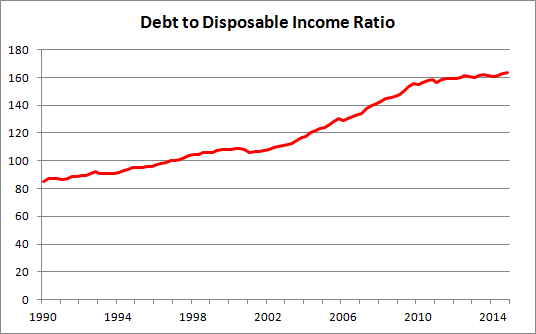
The problem with this strategy is that debt cannot grow indefinitely. In the 1990s, Canadian debt to disposable income levels were under 90%. Today, they’re over 160%, above the levels in the USA when their housing bubble popped.

Savings rates in Canada are at record lows. British Columbians have had a negative savings rate for years. If they simply begin to spend only what they make, it will have a major negative impact on the economy. If they actually try to save again (or really, actually start paying off their debt), then it will be even worse. It will cause a recession or a depression.

The long term impact will likely be severe for many people, because a house isn’t a retirement plan. A large subset of Generation X is dumping all its income into bricks and won’t have the liquid assets needed to retire. When the leveraged bet on overpriced real estate fails, many will be wiped out and unable to recover.

Recently, there has been talk about the hollowing-out of the middle-class. Well, the middle-class in Canada is doing it to themselves by buying overpriced land.

The way out

The problem now is that there are really no good options to avoid the consequences of this bubble—it’s been going on too long and become too large for there not to be major casualties when it pops. So now, the Bank of Canada is starting to examine a new option to minimize the pain of a housing crash. I like to call their proposed solution, “reward speculation, punish prudence”.

My Latest Experiment on my Kids

Kids and parents often have conflicts when it comes to food–it is not unusual to see parents forcing their children to eat. Our philosophy is a bit different, mostly based on Ellyn Satter’s work. Essentially, our strategy is to establish an eating routine. We don’t make special food for the children, but give them a variety of options at meals, including a dessert. Though the volume of dessert is limited, other than that, for every meal, our kids can eat as much as they want, in whatever order they want.  Outside the meal, they do not eat.

The theory is that kids are self-regulating, eating both the quantity and type of food they need. If a parent decides that instead of the kid regulating themselves, should regulate them (e.g. by forcing them to eat or stopping them from eating), then they run the risk of messing up the systems that enable them to self-regulate. So, we sit our kids down at a table with healthy food, let them decide themselves what to eat, and don’t hassle them.

So far, this strategy seems to have worked. The parents are not frustrated and the kids haven’t died of malnutrition. Occasionally our kids do decide to eat nothing at a meal. And at many meals, they eat dessert first. However, it’s also true that sometimes a child will decide that they don’t want their dessert, but want more cucumbers instead.

My wife is away for a few days, so I thought it would be interesting to see what the children would pack in their own lunches, given the choice.  This isn’t part of our eating strategy normally. The parent is supposed to decide what food goes on the table, not the child.

But really, what’s the point in having kids, if not to experiment on them? So what the heck….

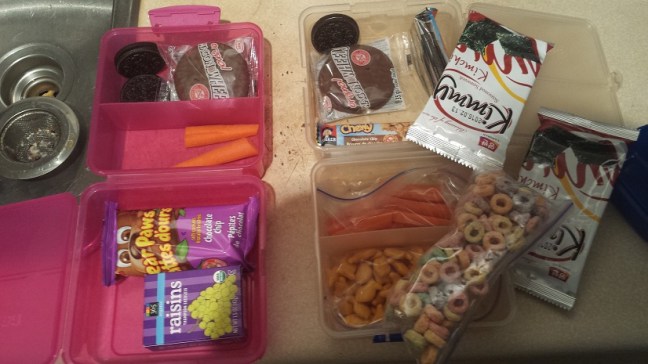
I went shopping with the kids. With a few exceptions (e.g. no soft drinks), I allowed them to pick up what they wanted for their lunch. Then we laid it all out on the counter and they chose themselves what they wanted.

As the photo above shows, the results were skewed towards sugar and unhealthy foods. In fact, even carrots and raisins–two foods I’d consider healthy–are fairly sweet. Nevertheless, I found it noteworthy that, though they like sweets, the children still seemed to recognize that having nothing to eat but sweets for the entire school day might be a bad idea. They didn’t have to choose carrots and seaweed, yet they did.

So what can we conclude from this experiment? Nothing major, except the experience was fun for all of us….

Clash of Clans–The Social Internet on Training Wheels

In my last post, I talked about using online gaming to teach children online skills. Recently, we’ve been doing this through Clash of Clans.

Clash of Clans is a combination of a tower defence game and Farmville. Players harvest or pillage resources to build bases to defend against other players. Players can form clans, groups that share resources, chat, and fight as a team to win wars.  Each clan has leaders, co-leaders, and elders, with varying degrees of clan management capabilities.  As such, clan members’ online interactions can be regulated by the leaders and co-leaders of the clan. This dynamic makes clash of clans a great game for learning some of the lessons of online safety.

Our 3 magic rules

I started playing Clash of Clans soon after my son picked it up. He started a clan, and I was soon a co-leader.  Fairly early on, we put in place several simple rules for being in the clan.

  1. Only people we know can join the clan: This game is played by adults and children all over the world. By only allowing people we know, we end up with a safe environment that includes kids and parents who share the same ideals. I imagine as the kids get older, we will relax this requirement for other games. After all, on the Internet, they will encounter many strangers and need to learn how to interact with them. But today we have a few seven-year-olds in the clan, so it’s reasonable to restrict who we allow in.
  1. No inappropriate language: Because we have young clan members and because we want to be decent people, swearing and racist language is forbidden.
  1. No jerks: I stole this rule from someone who uses it when building real-life work teams. In general, we all want to work and play with people who aren’t jerks. Someone might be good at their job–or great at the game–but if they’re mean or obnoxious, they can still ruin the experience for the people around them. So, we disallow jerks. Defining “jerk” seems like an issue, but in real life, it really isn’t. This isn’t a court of law. I don’t think we’ve ever had a disagreement over whether someone’s being a jerk.

One of the nice, non-obvious effects of this sort of rule is that it encourages leaders to be kind. There have been times we’re I’ve been contemplating taking an action to strengthen the clan (i.e. make us better at the game), but then decided not to because it was a mean thing to do. I would be breaking the “no jerk rule”. In a game with a bunch of adults, maybe that doesn’t matter. When trying to teach kids that treating other people well is more important than winning at a game, I think that matters a lot.

I am The Law!

Every one of these rules have been violated more than once. Much of the time, I view this as a good thing, since it typically leads to a discussion about the rule and its consequences. The consequences vary, from a warning, to temporary booting from the clan, to a permanent banishment.

One of the rule violations I’ve found surprising is kids making racist comments. I think in every case, these comments haven’t originated from the kid, but rather from music, TV, or movies. Typically, the child doesn’t even realize that they are being racist. Thus, such comments provide an opportunity to for discussing racism.

A second interesting scenario (which has also happened more than once) has been someone lending their device and account to someone else, and having that individual grossly violate our language and jerk rules. Typically, the rule violation by the borrower is deliberate. They see trolling as fun, with no negative consequences to themselves.

However, in our clan, that isn’t the case, because we know everyone in the clan, and most of the trolls as well. The account owner is typically booted for several days and demoted, which causes them frustration and anger. This anger is usually directed at the troll, who sees that there is a negative real-world consequence to their trolling. What’s more, sometimes the troll’s parents find out about it, which leads to productive conversations there, as well. Consequently, the player learns about the risk of sharing accounts and the troll learns that being a troll can be a bad idea with actual real-world consequences.

The bottom line

The real-world consequences of online interactions are the key thing that I hope my children will learn from these “Internet with training wheels” social games. I want them to understand that, just because the interaction is online, doesn’t mean that they won’t hurt someone’s feelings if they say something mean. Things they do online can come back and bite them in the real world. If they learn these lessons at ten, I hope it will reduce the chance of them learning about the real-world consequences of things like sexting when they’re four years older and the training wheels come off.

Social Gaming for Pre-Teens

Children playing Mariocart

I have two children, seven and eleven, and the eleven-year-old is transitioning from focusing from console and single player games to broader, internet-based games that often have a social component. As a parent, I view this transition as both a risk and an opportunity.

Here there be dragons

The key challenges with children gaming on the Internet are exposure to adult-oriented content, disclosure of personal information, and inappropriate social interactions.

In-game adult-orient content is easy to avoid in non-social games. Like movies, most games have ESRB ratings and for most games, any web search will let you decide whether the content is appropriate for your child. Social content, however, is more problematic. This content is generated by the players themselves. Even if the game is appropriate for your child, players within the game may say inappropriate things.

The disclosure of personal information is a relatively small issue in gaming compared to other Internet activities such as social networking (e.g. Facebook and Twitter).  However, it is still desirable that children do not reveal significant personal information within social games.

Inappropriate social interactions happen in many social settings online, but particularly in gaming. The challenge is two-fold. First, people are often more aggressive and rude online, willing to say things that they would never say to a person’s face. Second, tone is difficult to convey in non-verbal online communications, so it is easy to misunderstand what someone’s saying or inadvertently hurt someone by with a rude comment. The competitiveness and emotions related to gaming can magnify this issue.

Social gaming as an opportunity

Despite these problems, I view social gaming as more of an opportunity than a risk. It’s inevitable that, at some point in their lives, our kids will spend a significant amount of their time interacting with people online. They will chat, exchange pictures, email, post on message boards, create social media profiles, and do video conferencing. Thus, there is a huge amount of value in learning online social skills in a safe environment, before they are expected to interact online like adults.

In this respect, social gaming is an opportunity by providing a sandbox for learning these Internet skills. Many of the broader issues with socializing over Internet can be examined and discussed in less risky and more limited way through social gaming.

For instance, revealing personal information through a chat in a video game is much less likely to cause future real-world problem than posting personal information to Facebook. Thus, when the child posts that personal information in a game–as they inevitably will–it invites a discussion about the issues related to revealing personal information on the Internet. In this way, you can teach your child that it’s important to think before posting information online.

Similarly, online games tend to be transitory. The child will likely encounter inappropriate social interactions and they will likely be hurt by the things that other people say.  And, there’s a good chance that they will accidentally or deliberately say something hurtful to someone else. Both cases are a learning experience and an opportunity to talk about what is inappropriate to do online. What’s more, unlike much of the Internet, the mechanics of the games themselves will often have a method of dealing with inappropriate social interactions.

The bottom line

So in many respects, I view online gaming as the social Internet on training wheels. Inevitably, your child will have issues, but social games can be a good way to learn safe social Internet guidelines. In my next blog, I’ll discuss how we have dealt with some of the social issues that have arisen in Clash of Clans.